



Produktserie: Ben- & Ledhälsa
Alle produkter i denne kategori
-
 2nd with 50%
Glukosamin & Kondroitin
180 kapslar | Kosttillskott för leder för hund och katt
Ordinarie pris 255,00 KrOrdinarie prisEnhetspris per -
 2nd with 50%
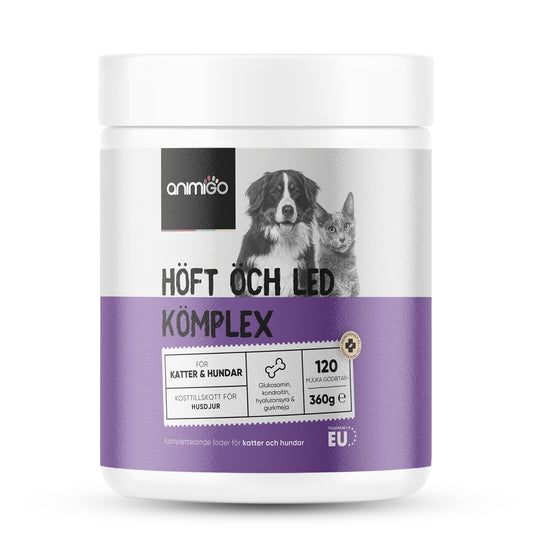
Hip & Joint Complex Soft Chews
120 pcs | For strength and mobility
Ordinarie pris 249,00 KrOrdinarie prisEnhetspris per


Our dogs are so much more than just pets. They are our companions, friends, protectors, and most of all, family members. In the same way we help people suffering from joint problems, your dog may also need help. Our four-legged friends can also suffer from joint pain and stiffness, so it's just as important to take care of joint health in dogs as in humans. But how do you know if the problem is in the joints or somewhere else? And how can you help your dog with their joints?
What are the symptoms of joint problems in dogs?
Have you noticed that your usually active dog has difficulty running the same way as before? Or does your dog have trouble getting up the stairs or into bed? Joint pain in dogs is a problem that normally develops slowly; it starts with minor discomfort and gets worse over time. It can be difficult to notice, as it usually just starts with your dog becoming less active. If their joints worsen, it can lead to them no longer being able to jump onto the sofa or get in and out of the car. After that, it can lead to the dog starting to limp or move strangely due to joint dysfunction.
What causes joint pain in dogs?
Joint problems can be divided into two different categories: developmental disorders and degenerative diseases. If your dog has developmental disorders, it means that the bones and joints have not developed properly. Degenerative joint problems refer to the joints, bones, or ligaments slowly being damaged. This can be due to several factors, the most common of which are old age, accidental injury, overweight, and general wear and tear.
Dog breeds prone to joint problems
All dogs can get joint problems, but unfortunately, some breeds are more prone to them than others, which means you should be extra careful to provide appropriate and preventive joint care for dogs in the risk group. This often applies to larger dogs due to their size and weight, but there are also breed-specific joint problems. The breeds most often affected by various joint problems are: German Shepherd, Labrador, Dachshund, Rottweiler, Newfoundland, Great Dane, St. Bernard, Old English Sheepdog, and Mastiff.
What is osteoarthritis in dogs?
A dog with osteoarthritis has inflammation in the joints. It is a common condition in both dogs and humans. A healthy dog's joints are covered with a layer of cartilage and synovial fluid so that the ends of the bones can move against each other without friction. When a dog develops osteoarthritis, the joint cartilage surface breaks down, and the bones rub against each other, leading to pain, discomfort, and stiffness.
Osteoarthritis occurs when the joints have become so worn that they have suffered permanent damage, but if you suspect that your dog is starting to have joint problems that could lead to osteoarthritis, there are some ways to prevent it before it becomes more serious.
How can I prevent stiff joints in my dog?
The most common forms of pain relief for joint pain in dogs can be divided into surgical and natural methods. If you suspect your dog has joint pain or severe joint problems, or if you think it's developing, the first step is to take them to the vet. A stiff dog that limps should be thoroughly examined by a vet who can make a diagnosis and advise you on how to remedy the problems.
Natural joint care for dogs
If your dog does not need surgery, there are fortunately many other options that can help your dog's joints. To tackle the problem, you must first find the cause of the joint problems. If your dog has developed bad joints due to weight gain, the solution may be to change their diet and get them to exercise more to lose weight. If the problems are due to general wear and tear, you can try to reduce their activity level and entertain them with other tasks that do not require as much physical exertion.
If the problems are due to age, you unfortunately cannot turn back time, but you can try taking your dog on shorter and slower walks. You can also make sure that everything they need is at a lower level, such as their bed, food, and toys. Physiotherapy for dogs has also become very popular lately, and there are professional joint care programs for dogs of all shapes and sizes.
Nutrition for bone and joint health
A good way to prevent pain and stiffness in your dog's joints is to ensure they get the right nutrition; some of the best remedies for dog joint health are in their food or supplements, and you don't always have to resort to medication. Start by making sure your dog doesn't eat too much processed or grain-based food, and always try to avoid preservatives and chemicals.
Once you've made sure there's nothing negatively affecting your dog in their food, you can focus on improving their diet. You can start by including healthy fats; omega-3 and -6 fatty acids, often found in fish oils, are excellent for this. Other good ingredients for dog joints are glucosamine and chondroitin, which can help repair joints and keep them mobile. Ginger and turmeric are beneficial foods because they act as anti-inflammatory agents. Giving your dog plenty of vitamins and minerals is good for their joints and also fantastic for the rest of their body.
Preventing joint problems in dogs
One of the best ways to prevent your dog from developing joint problems is to take care of their joints from a young age. Providing your dog with preventive joint health care doesn't have to be difficult; the best way is to give them the right nutrition for joint health throughout their lives and to monitor their activity and follow breed-specific precautions as closely as you can. So don't wait until it's too late to take care of your dog's joints; prevent them before the problems arise!


